Digital Health Roles for US and UK Doctors and Nurses: Which Path Is Right for You?
Written by Rod on February 16, 2026
When doctors and nurses begin exploring digital health roles, they are often overwhelmed by the alphabet soup of job titles: clinical informaticist, digital nurse specialist, CNIO, CMIO, CCIO, clinical safety officer, medical director (health tech), clinical AI lead, virtual care lead, and many more. Behind the jargon, there are really only a handful of core career paths that suit different personalities, clinical backgrounds, and life priorities. Understanding these main routes helps you stop feeling lost and start recognizing which direction actually fits you—your strengths, your tolerance for meetings, your appetite for change management, and whether you want to stay close to patients or move further into strategy and product.
Behind the jargon, there are really only a handful of core career paths that suit different personalities, clinical backgrounds, and life priorities. Understanding these main routes helps you stop feeling lost and start recognising which direction actually fits *you* — your strengths, your tolerance for meetings, your appetite for change management, and whether you want to stay close to patients or move further into strategy and product.
This article breaks down the primary digital health roles for US and UK clinicians in 2026, explains what the day-to-day really looks like, and gives clear “this suits you if…” guidance for both doctors and nurses.
The main digital health paths for clinicians
In 2026, most clinicians who successfully transition fall into one (or a blend) of these five broad categories:
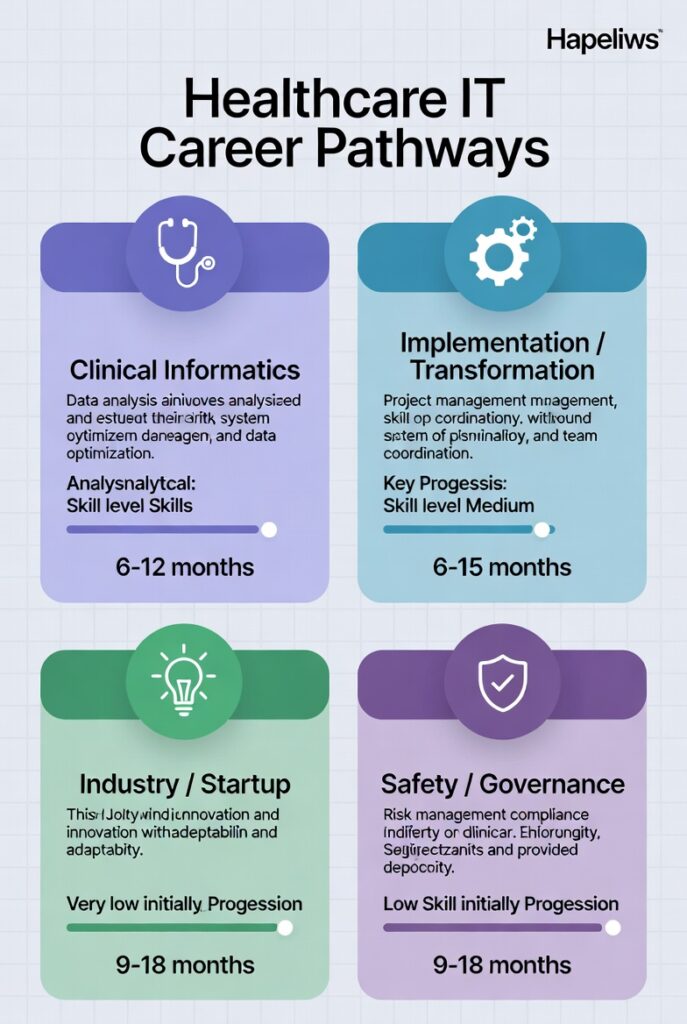
1. **Clinical informatics & EHR/EPR optimisation**
2. **Implementation, transformation & change management**
3. **Industry & health-tech company roles** (startups to big tech)
4. **Clinical safety, governance, quality & risk**
5. **Leadership & strategic roles** (CNIO, CMIO, CCIO, VP Clinical, etc.)
Demand remains very strong across all five paths. Hospitals, integrated care systems, large health-tech vendors, startups, and regulators are all short of clinicians who can bridge the gap between frontline care and technology.
Clinical informatics and EHR/EPR roles
These roles focus on making electronic health records (Epic, Cerner, Meditech, SystmOne, EMIS, etc.) actually work for clinicians rather than against them. You spend time configuring templates, building order sets, optimising documentation workflows, integrating AI ambient scribes, and reducing clicks.
Typical activities in 2026
– Redesigning discharge summaries and ward rounds using generative AI tools
– Improving usability of virtual ward monitoring dashboards
– Leading data quality initiatives for AI-driven risk stratification
– Training colleagues and creating quick-reference guides
This suits you if… (doctors)
You are analytical, detail-oriented, and quietly frustrated by inefficient charting and poor decision support. You enjoy solving puzzles and making small changes that save everyone time.
This suits you if… (nurses)
You are process-driven, good at spotting workflow bottlenecks on the ward, and naturally teach others how to use systems better. You like tangible, measurable improvements in daily work.
Salary range (2026 approximate)
US: $120,000–$185,000
UK: £80,000–£130,000 (higher in London and large trusts)
Entry routes
Internal super-user → informatics analyst → clinical informaticist. Certifications (Epic, Cerner, NHS Digital badges) help significantly.
Implementation and transformation roles in hospitals
These positions are about actually getting new digital tools live and adopted. You work on large-scale roll-outs (new EPR, virtual ward expansion, AI documentation pilots) and help clinical teams change the way they work.
Typical activities in 2026
– Running workshops and super-user training for AI scribe adoption
– Managing go-live for remote monitoring platforms
– Measuring adoption rates and fixing resistance hotspots
– Co-designing new care pathways that combine in-person and virtual elements
This suits you if… (doctors)
You are respected by peers, good at influencing senior colleagues, and comfortable leading change even when it’s unpopular at first.
This suits you if… (nurses)
You are highly organised, excellent at communicating with multidisciplinary teams, and genuinely enjoy helping colleagues feel confident with new tools.
Salary range
US: $130,000–$195,000
UK: £85,000–£140,000 (senior transformation roles often higher)
Industry and startup roles for doctors and nurses
These are positions inside health-tech companies — from early-stage startups to large vendors (Epic, Cerner/Oracle, Google Health, Amazon, Microsoft, Dedalus, etc.) and digital health scale-ups.
Typical activities in 2026
– Acting as clinical lead on generative AI documentation products
– Advising on safe implementation of clinical decision support algorithms
– Shaping virtual care and remote monitoring product roadmaps
– Conducting clinician usability testing and safety reviews
– Working as medical/science director or clinical product specialist
This suits you if… (doctors)
You are entrepreneurial, excited by innovation, and happy to work at pace in a less structured environment. You enjoy strategic thinking and don’t mind occasional travel.
This suits you if… (nurses)
You are adaptable, good at translating clinical needs into product requirements, and interested in scalable impact rather than individual patient care.
Salary range
US: $150,000–$250,000+ (equity often included)
UK: £100,000–£180,000+ (equity less common)
Many of these roles are partly or fully remote.
## Safety, governance, and quality roles in digital programmes
These clinicians focus on risk identification, patient safety, regulatory compliance, and safe deployment of digital tools (especially AI and generative systems).
Typical activities in 2026
– Carrying out clinical safety assessments of AI ambient scribes and chatbots
– Contributing to DCB 0129 / 0160 safety cases (UK) or similar risk frameworks (US)
– Reviewing bias and equity issues in predictive algorithms
– Leading post-deployment monitoring of virtual care pathways
This suits you if… (doctors)
You have a strong risk-management mindset, enjoy root-cause analysis, and want to protect patients at a systemic level.
This suits you if… (nurses)
You are meticulous, naturally patient-centred, and want to ensure new technology doesn’t create new harms.
Salary range
US: $140,000–$210,000
UK: £90,000–£150,000
Leadership and strategic roles (CNIO, CMIO, CCIO, etc.)
These are senior positions that combine clinical credibility, digital vision, and organisational leadership.
Typical activities
– Setting digital strategy for a trust / health system
– Chairing digital clinical boards
– Representing clinical needs to C-suite and board
– Leading large-scale transformation programmes (EPR replacement, AI adoption, virtual care expansion)
This suits you if…
You are already in (or close to) consultant / senior nurse / matron level, enjoy politics and strategy, and want to influence at the highest level.
Salary range
US CMIO / equivalent: $220,000–$400,000+
UK CNIO / CCIO: £120,000–£200,000+
“Is this for me?” — how to choose your first direction in 2026
Use these quick questions to narrow your focus:
– Do I prefer deep technical problem-solving → **Clinical informatics**
– Do I enjoy leading people through change and training → **Implementation & transformation**
– Do I want faster pace, innovation, and potential equity → **Industry / startup**
– Am I most motivated by safety and risk prevention → **Safety & governance**
– Do I already have seniority and want big-picture impact → **Leadership roles**
Most people start with **internal clinical informatics or implementation experience** — it’s the lowest-risk entry point and keeps your clinical credibility intact.
Next steps
Not sure where you fit yet? That’s normal.
Start here:
– Read the job descriptions for 3–4 roles that intrigue you on NHS Jobs, LinkedIn, Indeed, or health-tech company careers pages
– Reach out to 1–2 people doing those roles for a 15-minute chat (most are generous with their time)
– Download the free “Which Digital Health Path Fits You?” self-assessment guide at rodgamble.com
Once you have a clearer sense of direction, the roadmap in the previous article becomes much easier to follow.
You already have the rarest asset in digital health — real clinical experience. Now it’s just a matter of pointing that expertise in the right direction.
Take the quiz at the bottom, get started today: