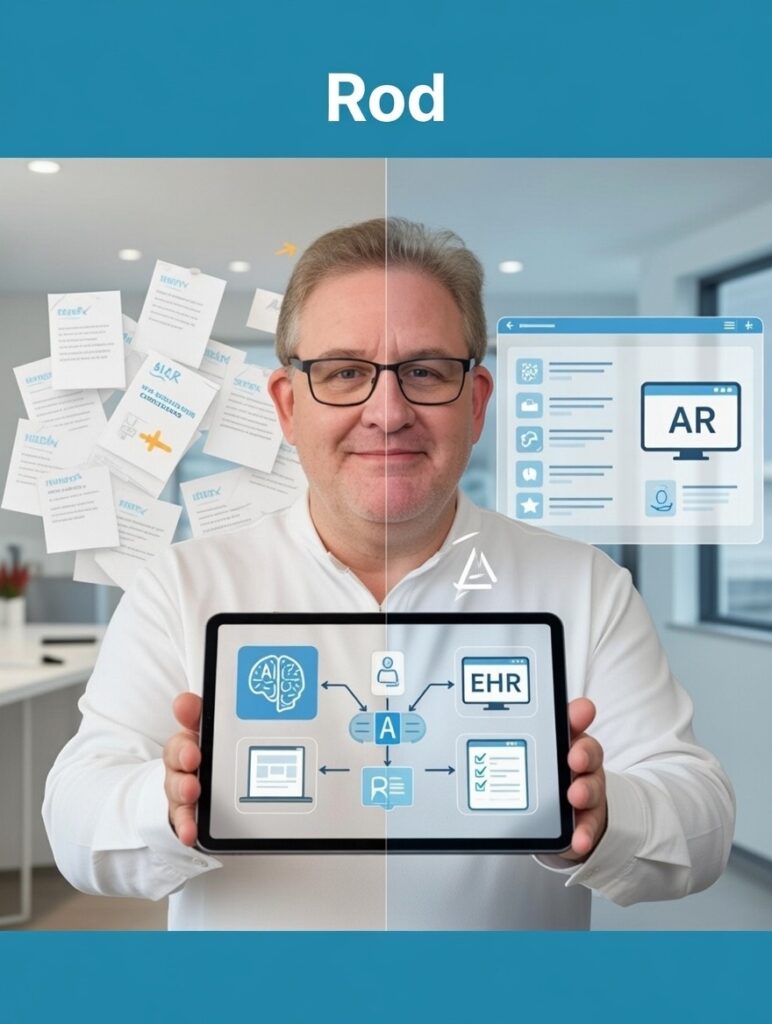
The Last Analogue Decade: Why Clinicians Must Go Digital-First Now
Written by Rod on February 2, 2026
Digital-first healthcare isn’t coming—it’s already here. While you work bedside shifts, rural Pakistan deploys AI diagnostic tools and the NHS builds national virtual ward infrastructure. The question isn’t whether your clinical role will transform, but whether you’ll shape that transformation or be left behind when analogue systems are deliberately switched off.
If you qualified in a paper-based hospital, that world is being deliberately switched off.
I know this sounds dramatic, maybe even alarmist. But I’ve watched this transformation twice now—first as it unfolded in the United States, then again as I traveled the world and saw the pattern repeat at breathtaking speed. The moment I truly understood we were living through healthcare’s last analogue decade came not from working in London or New York, but from walking into a rural health clinic in Pakistan.
The Realization That Changed Everything
When I first left the United States for international digital health work, I expected to see the rest of the world lagging behind. The US was well ahead in digital health transformation—arguably still is—and I figured I’d be helping other countries catch up to where America had been five years earlier. I was prepared for paper charts, manual processes, and the slow grind of convincing skeptical clinicians to adopt basic electronic systems.
What I found instead stopped me cold.
The US digital health industry was recalibrating. We’d answered the question “how do we get rid of this paper?” and now faced a new challenge: “what do we do with all this data?” That shift—from elimination of paper to optimization of data—marked the fundamental transition from analogue to digital-first healthcare. We weren’t debating whether to go digital anymore. We were debating how to make digital systems serve clinical needs better.
Then I started working in the developing world. Kenya. Pakistan. Places where healthcare infrastructure was being built from scratch or rebuilt after decades of underinvestment. And here’s what stunned me: they weren’t installing paper systems with plans to digitize later. They were skipping paper entirely.
Rural clinics in Kenya tracking maternal health through mobile platforms. Community health workers in Pakistan using AI-powered diagnostic tools to triage patients before they ever saw a physician. Entire national health systems designing around digital-first infrastructure because building paper systems first, then converting them, made no economic or practical sense.
If places like Kenya and Pakistan are bypassing paper and embracing a digital future, it must truly be upon us. The analogue era isn’t fading slowly—it’s being deliberately switched off, globally, right now.
The NHS Blueprint for Digital-First Infrastructure
While I was watching this transformation in developing nations, the UK’s National Health Service was making the same calculation—just with more explicit policy language and bigger budgets.
NHS England is building a national AI screening platform (AIR-SP) designed so trusts can plug into AI tools at scale for cancer and other conditions. The stated goal? Explicitly “shifting care from analogue to digital.” Not improving analogue care. Not supplementing paper-based systems. Replacing them entirely with digital infrastructure that’s AI-enabled from the start.
A new National Commission has been established with a mandate to make the NHS “the most AI-enabled healthcare system in the world.” Their focus areas read like a blueprint for digital-first healthcare: AI assistants for doctors, AI-enhanced imaging and pathology, remote monitoring systems that replace in-person observation. These aren’t pilots anymore—they’re infrastructure investments.
NHS virtual wards demonstrate how quickly “experimental” digital care becomes standard capacity. Virtual wards were framed as emergency innovations during COVID-19. Now they’re core capacity strategy, with targets of 40-50 virtual beds per 100,000 population. All ICBs (Integrated Care Boards) are now running virtual ward programmes. The NHS explicitly describes this as a “larger-scale digital project,” not a temporary workaround.
The pattern is unmistakable: healthcare systems are building digital infrastructure as the default, with analogue processes treated as legacy systems to be phased out.
Why “Non-Digital” Is Becoming Unemployable
Here’s the uncomfortable comparison I keep returning to: staying “non-digital” in healthcare is becoming like being a pilot who refuses to use modern avionics.
Fifty years ago, skilled pilots could fly entirely by visual reference and basic instruments. That expertise was valuable. But as aviation technology advanced, pilots who refused to learn instrument flight rules, autopilot systems, and digital navigation became unemployable—not because they were bad pilots, but because the infrastructure they’d need to operate safely no longer existed.
You can’t fly commercial routes using 1970s-era navigation when air traffic control, airport systems, and aircraft themselves are built around digital integration. It’s not about your skill. It’s about compatibility with the system.
Healthcare is reaching that same inflection point. When patient records are digital, clinical decision support is AI-powered, and care coordination happens through integrated platforms, clinicians who position themselves as “non-digital” won’t just be old-school—they’ll be incompatible with the infrastructure.
This isn’t about replacing clinical judgment with algorithms. It’s about whether your clinical judgment can interface with the systems that will define healthcare delivery for the next fifty years.
The Recalibration I Watched Happen
That temporary drop in US digital health work I experienced when I first left the country? That was the market recalibrating around a fundamental question change.
Phase One (roughly 2008-2018): “How do we get rid of paper?” Healthcare organizations needed help digitizing. Electronic patient records. Digital documentation. Scanning old files. Converting analogue workflows to digital equivalents. The expertise needed was implementation—getting clinicians to adopt unfamiliar systems.
Phase Two (roughly 2019-present): “What do we do with all this data?” Healthcare organizations need help optimizing. Predictive analytics. AI-powered early warning systems. Population health management. Interoperability between systems. The expertise needed is integration—making digital systems serve clinical needs better.
Phase Three (starting now, accelerating through 2030): “How do we deliver care that’s digital-first?” Healthcare organizations will need help redesigning. Care models built around virtual monitoring. AI as standard decision support. Clinical roles that assume digital tools rather than adapt to them. The expertise needed will be transformation—creating clinical practices that couldn’t exist in the analogue era.
The developing world is jumping straight to Phase Three because they never built Phase One infrastructure. Developed healthcare systems are scrambling to get there while managing legacy analogue processes.
The question for individual clinicians: which phase describes your current skill set?
The Choice You’re Actually Making
In 5-10 years, healthcare will be unrecognizably different from what most clinicians trained in. Virtual wards will be standard capacity, not innovative pilots. AI screening will be regulatory requirement, not experimental technology. Clinical documentation, care coordination, patient monitoring, and diagnostic support will assume digital integration.
You have a choice right now that won’t be available in five years.
Option One: Position yourself as a clinician shaping these systems. Learn how AI works in clinical contexts. Understand virtual care models. Develop expertise in how digital tools amplify rather than replace clinical judgment. When healthcare organizations desperately need clinicians who can guide digital transformation, you’ll be essential and highly compensated.
Option Two: Wait to see if this is really necessary. Assume your clinical skills will remain valuable regardless of the digital shift. Hope that healthcare will always need bedside clinicians who prefer analogue workflows. Risk discovering that the infrastructure supporting analogue practice has been switched off while you were waiting.
Option Three: Actively resist digital transformation. Position yourself as defending “real” patient care against technology. Watch opportunities disappear as healthcare systems build around digital-first models that you can’t or won’t engage with.
I’m not arguing that everyone should become a programmer or abandon patient care. I’m arguing that clinical expertise in the next decade will assume digital literacy the same way it currently assumes basic computer skills.
The clinicians who thrive won’t be the ones who can code—they’ll be the ones who can ensure AI serves patients effectively, who can redesign workflows around virtual care, who can bridge the gap between what technology promises and what clinical reality requires.
The Transformation You Can’t Stop
When I walked into that clinic in Pakistan and saw community health workers using AI diagnostic tools in areas without reliable electricity, I understood something profound: the analogue era is ending not because of technology advancement, but because digital-first infrastructure is now the most practical solution even in resource-limited settings.
If rural Pakistan is building digital-first, paper-based healthcare is finished globally.
The NHS is making this explicit with national AI platforms and virtual ward mandates. Developing nations are proving it by skipping analogue entirely. The question isn’t whether your clinical role will become digital-first—it will. The question is whether you’ll shape that transformation or be shaped by it.
This is your moment to decide. The infrastructure is being built right now. The roles are being defined. The opportunities for clinicians who understand both patient care and digital tools are extraordinary—but they won’t last forever.
In ten years, “digital-first clinician” will be redundant because there won’t be any other kind. Get positioned now, while there’s still a premium on the expertise you already have.
If you’re wondering how to translate your clinical expertise into digital-first capability before the analogue world disappears completely, let’s talk about positioning you for the transformation that’s already happening. The professionals who prepare today will be the ones defining healthcare tomorrow.
References
[1] UK Government (2025). AI to be trialled at unprecedented scale across NHS screening. https://www.gov.uk/government/news/ai-to-be-trialled-at-unprecedented-scale-across-nhs-screening
[2] Policy@Manchester (2024). Implications of the digital revolution for the nursing workforce. https://blog.policy.manchester.ac.uk/posts/2024/03/implications-of-the-digital-revolution-for-the-nursing-workforce/
[3] UK Government (2025). New Commission to help accelerate NHS use of AI. https://www.gov.uk/government/news/new-commission-to-help-accelerate-nhs-use-of-ai
[4] NHS Confederation (2025). Realising the potential of virtual wards. https://www.nhsconfed.org/publications/realising-potential-virtual-wards
[5] eWIN NHS (2025). Evidence Brief: Virtual Wards. https://www.ewin.nhs.uk/sites/default/files/Virtual%20Wards_Evidence%20brief%20(1).pdf