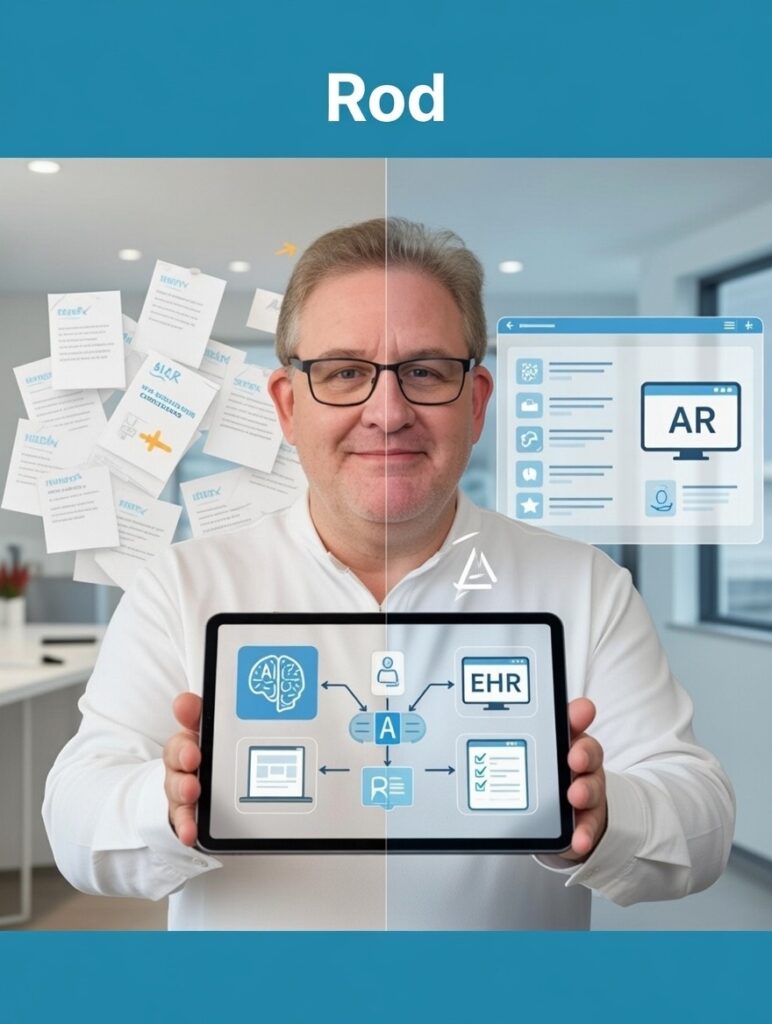
Harnessing AI in Healthcare: How Clinicians Can Lead Digital Transformation
Written by Rod on March 23, 2026
If you’re a nurse or doctor drowning in documentation and wondering whether AI is coming for your career, it’s time to reframe the question entirely. Harnessing AI in healthcare for clinicians isn’t about being replaced — it’s about becoming the most valuable person in the room. Across the US, UK, and Ireland, burned-out healthcare professionals are discovering that their real-world clinical expertise is exactly what the AI revolution needs most, and that stepping into digital health leadership roles means more impact, better pay, and finally leaving the exhaustion of bedside work behind.
As Coach Rod, I’ve coached numerous clinicians through this shift, watching them move from bedside exhaustion to influential roles in digital health. AI isn’t about machines taking over—it’s about empowering humans to do what they do best: care for patients. Recent trends show AI transforming healthcare in 2026, with tools supporting diagnostics, risk assessment, and administrative tasks, allowing more time for patient interactions. In fact, generative AI (gen AI) is poised to deliver significant value across operations, from personalized care to efficient workflows.
The AI Revolution in Healthcare: Why Clinicians Are Essential
AI is exploding in healthcare, driven by advancements in machine learning and data analytics. In 2026, key trends include AI aiding real-time diagnosis, such as detecting heart disease or colon polyps during procedures, and creating “digital twins” for personalized treatment plans. Health systems are rolling out AI for automation, with funding surging into startups that promise cost savings and better outcomes.
But amid this hype, clinicians like you are the missing link. Tech companies need your real-world insights to ensure AI tools are ethical, accurate, and patient-centered. Without clinical input, AI risks becoming just another inefficient gadget. In the UK and Ireland, where NHS and HSE systems are adopting AI for virtual wards and predictive analytics, clinicians leading these transformations are seeing their impact multiply—from treating individual patients to optimizing entire systems.
Addressing Common Fears: Maintaining Your Clinical Edge
Many doctors and nurses worry that diving into AI means deskilling or abandoning patient care. “Will I lose my edge?” is a question I hear often. The answer? Absolutely not. AI handles repetitive tasks like documentation and data analysis, freeing you to focus on complex diagnostics, empathy-driven care, and innovation. Studies show AI adoption among physicians has surged 78% year-over-year, with tools embedding into workflows without replacing human judgment.
In my coaching, I’ve seen nurses transition to AI oversight roles where they train models on clinical data, ensuring accuracy while staying sharp through hybrid positions. Digital transformation doesn’t erode your skills—it enhances them, turning you into a leader in healthcare technology.
Key Roles for Clinicians in AI-Driven Healthcare
Opportunities abound in clinical informatics, AI ethics committees, and health tech consulting. Roles like Chief Medical Information Officer (CMIO) or AI clinical leads blend your expertise with tech, offering salaries from $150,000-$300,000 in the US, and £80,000-£120,000 in the UK/Ireland. Agentic AI—systems that act autonomously—is emerging, handling tasks like appointment rescheduling, but always under clinician supervision.
Imagine leading digital health projects where AI predicts patient declines or personalizes treatments, impacting thousands. This is clinical innovation at its best, aligning with healthcare transformation goals.
Steps to Transition: Building Your AI Expertise Without Starting Over
Getting started is simpler than you think. Here’s a practical roadmap:
- Self-Assess: Identify transferable skills—your workflow knowledge is perfect for AI optimization. No coding required; focus on understanding AI basics.
- Upskill Smartly: Take short courses in health informatics or AI ethics via platforms like Coursera or HIMSS. Aim for 30-60 hours over weeks.
- Network and Explore: Join LinkedIn groups with #HealthcareAI or attend webinars on 2026 trends. Connect with pros who’ve made the switch.
- Pilot Projects: Start small—volunteer for AI trials in your hospital or freelance as a clinical advisor for tech firms.
- Certify and Apply: Earn credentials like Certified Health Informatician, then target roles in telemedicine or AI-driven care platforms.
I’ve guided doctors who began with part-time AI consulting, quickly scaling to full-time leadership.
Real-World Benefits, Challenges, and Success Stories
The perks? Reduced burnout through automation, higher impact via system-wide changes, and competitive pay. One client, a UK nurse, now leads AI for mental health screening, reporting renewed passion. Challenges include data privacy concerns and regulatory gaps, but with governance frameworks evolving, these are manageable.
AI makes care more human by giving time back to caregivers, shifting from vibes to value in 2026.
Embracing the Future: Lead the Change in Digital Health
Harnessing AI isn’t about following trends—it’s about leading healthcare’s digital transformation while preserving what makes you a great clinician. With AI set to personalize care at scale and drive breakthroughs, now’s the time to step up. If you’re ready to explore, as your coach, I can help craft your path. Contact me for guidance on this exciting journey.
Word count: 852
References
- American Association of Nurse Practitioners. (2026). Top Five Health Care Trends for 2026.
- Medtronic. (2026). 6 Healthcare Tech Trends for 2026.
- Healthcare Dive. (2026). Top Healthcare AI Trends in 2026.
- Xsolis. (2026). AI Trends in Healthcare.
- Deloitte. (2025). 2026 US Health Care Outlook.
- Lightning Bolt. (2026). 5 Trends Shaping Healthcare in 2026.
- Cigna. (2026). The Top Health Care Trends for 2026.
- HealthStream. (2026). 2026 Healthcare Trends: AI, Quality, Compliance & Workforce Readiness.
- McKinsey. (2026). What to Expect in US Healthcare in 2026 and Beyond.
- Wolters Kluwer. (2025). 2026 Healthcare AI Trends: Insights from Experts.
- AdventHealth. (2026). 5 Ways AI Will Make Health Care More Human in 2026.
- BigR.io. (2026). What Does 2026 Hold for AI and Healthcare?